FYI x myprosperity: Taking automation to a whole new level
 

I am super excited to announce our latest addition to the myprosperity integration suite. From July 2021, accountants using document management and process automation specialist FYI can access myprosperity’s powerful client portal. You can offer your clients a holistic and seamless digital experience for managing all their financial affairs in one place. Increase your efficiencies and use that valuable time to unlock deeper client insights that surface new revenue opportunities for your practice.

Feedback from our beta clients has been incredibly positive with accountants excited by the blend of back office automation and creating an awesome client experience. A big shout out to Rob Cameron, Alan McLeod and the team at FYI. It’s always great to work with leading tech companies that share our passion for helping accountants and advisers to deliver a world-class experience to their clients.


Go paperless with a streamlined digital workflow


We’re always on a mission to streamline the digital experience for accountants and their clients. Whether that’s through technology that does the heavy lifting in how you engage and collect data from your clients to maximising efficiencies with digital document storage and signing. We want to ensure accountants can focus on what they do best – being the trusted advisor. This is why I’m thrilled to announce our integration with FYI, the must-have time saving solution for accountants with secure doc storage and signing at your fingertips. Using the combined power of our two platforms, FYI users can invite their clients to sign or upload documents within myprosperity. They are notified to join the portal, where their documents can be signed, then automatically stored on both platforms – giving you and your clients 24/7 access to important documents.


Unlock valuable client insights


While signing and adding documents is the gateway to the portal, there is much to be discovered about clients once their assets and accounts are added. Accountants can unearth unmet needs (opportunities) using the portal’s powerful analytics to generate new revenue streams, while providing clients with the best technology to oversee their entire financial world.


Continuing to build our ‘whole of wealth’ platform


With more and more households and clients joining myprosperity everyday, it’s important to us that we deliver a streamlined digital experience that delights and inspires, bringing their financial world into one place. FYI plays an important role in accelerating our vision for a ‘whole of wealth’ approach to financial services. But myprosperity’s workflow automation doesn’t stop here. Our team is determined to continue developing solutions that cut down accountant’s time spent on the mundane tasks. Our partnerships with leading software providers are what makes myprosperity an invaluable asset for the tech-led firm. I’m proud to see our integrations with the likes of Xero, BGL, and now FYI deliver tangible results as accountants draw together valuable insights in myprosperity and deliver meaningful outcomes to their clients.

If you would like an advanced screening of how FYI and myprosperity can transform your business please book a demo.

Peter McCarthy

Executive Director at myprosperity

Peter founded myprosperity in 2011 after 20 years in the financial services sector. Prior to that, he worked for Zurich Australia and founded his own successful financial planning firm, Strategic Financial Management, which acted for clients with a combined net wealth of over $1 billion.
Deeper client relationships at scale

Senior clients using advice tech

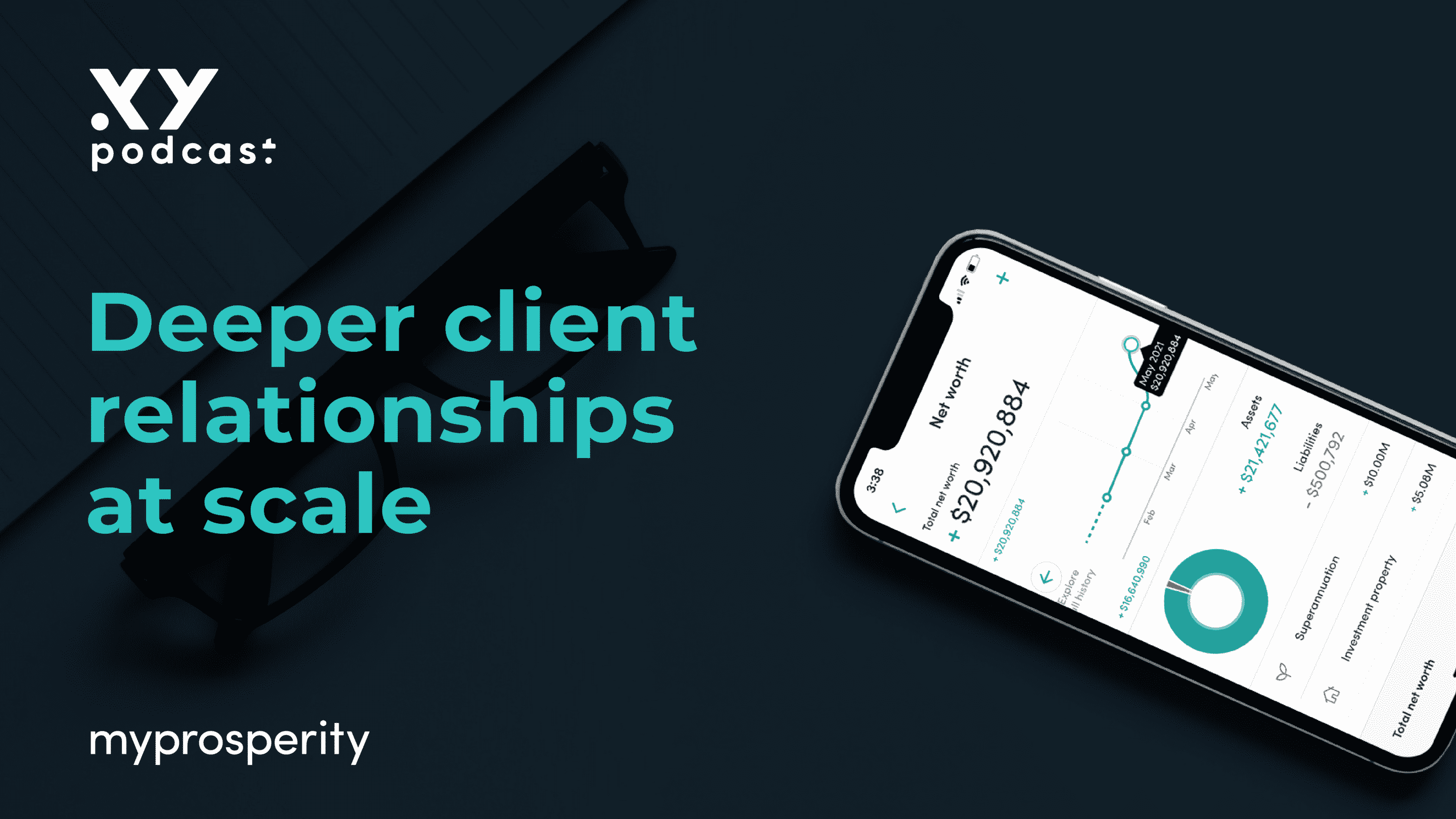
This week I had the pleasure of joining the XY Podcast, hosted by Fraser Jack, Head of Media for XY Adviser. In a series of five episodes, Deeper client relationships at scale, Fraser sat down with four advisers and experts to better understand how they build deeper client relationships, and how having the right systems, processes and technology helps them achieve scale. It was brilliant to hear from them and how they work behind the scenes to create the magic they deliver for their clients. After beginning my career in FinTech with MYOB, I joined myprosperity in the early days as the Territory Manager when there were only seven other employees. It’s been amazing to see our client portal solution for accountants and advisers grow, and as the Head of Wealth I love getting to know our community of financial professionals that value innovation at the core of their practice.

The series kicks off with Conrad Francis, Director of Inspired Money in Perth, WA. He shared valuable points on taking a goals-based approach to advice, which begins with gathering high-quality information about your client and “diagnosing before advising” in those early days in order to yield great results for them. Fraser also spoke with Conrad about the technology he uses to scale his practice and simultaneously deliver better outcomes for his clients. His beliefs on implementing the right technology to do the heavy lifting align with our philosophy here at myprosperity. “At its best, technology should be used to eliminate the busy work and allow advisers to focus on the clients’ goals,” said Conrad.

Another powerhouse in the game is Nicole Stuart, National Client and Compliance Manager for King Financial. Her perspectives on solid processes and systems as the foundation of a dependable compliance program were very insightful, and as you’ll hear, she talks about the importance of frequent process reviews to ensure efficiencies stay effective. With these processes in place, technology and automation are used to ease the burden. She attributes King Financial’s ability to expand and acquire multiple firms over the years to their sound integration process which involves assessing existing systems and cost structures, while comparing and implementing what works. This process takes place over a 12-month hand-over period that helps clients transition in a way that builds trust and confidence when working with new advisers. Nicole notes that communication is vital during this period, as keeping in regular contact with clients helps them to better adapt to changes, whether it be processes or technology.

Director and Principal Adviser of Fenton Financial, Andy Fenton is an experienced podcaster in his own right as co-host of Wealth, Wine and Wisdom. Speaking with Fraser, Andy highlights the importance of automated processes being as simple as possible, and how removing repetition from the advice process allows for greater focus on the client. With 90 per cent of his meetings and interactions now online, it lends itself to more focused and efficient advice giving. He also shares with us how his practice embraced technology in order to scale up, mainly through online courses and training, digital business management, videography and content creation.

Rounding out the four adviser interviews, Fraser spoke with Caren Hendrie, Business Growth Adviser and Trainer of Business Growth Group. Caren highlights the three most important factors in scale; systems, communication and technology. She also stresses the importance of focusing on improving one aspect at a time, rather than attempting to tackle all three at the same time. As far as communication is concerned, Caren shares that most clients want the human element from financial services that robo-advice cannot deliver – that feeling of importance and being valued. I couldn’t agree more with this, and it reminds me of a quote by Maya Angelou: “I’ve learnt that people will forget what you said, people will forget what you did, but people will never forget how you made them feel.” With the sheer volume of work that advisers have to do, scale becomes so important, especially for those firms who invest in the processes and tech stack earlier rather than later. People want someone that understands them. You can’t build trust with tech, tech is the enabler for human involvement to amplify client relationships. It’s important to keep in mind that technology can’t replace the human element, but instead can complement it.

And wrapping up this stellar series, Fraser and I had a great chat about how technology can not only help you create a consistent client experience but can also lead to deeper, more personalised client interactions. I also spoke about how some of our partners at myprosperity have implemented this philosophy using our client portal solution. The series goes live on June 17 and you can listen to it here. A special thanks to Fraser and the team at XY Adviser for putting together this great series for all the XY listeners out there. Happy listening!

Karolina Kuszyk

Head of Wealth at myprosperity

Karolina brings over 14 years experience in the Tech industry. Her previous role as a Field Partner Manager at MYOB, paved her way into the FinTech space. She joined myprosperity as employee number 8 and has played an instrumental role in driving growth since.

The case for senior clients and advice technology

Senior clients using advice tech


When it comes to managing the portfolios of senior Australians, it can be easy to make assumptions about your clients’ level of technological literacy. What if I told you that this demographic is just as eager as any other to engage with their advisers through technology? Are you meeting your clients’ digital expectations?

Stereotypes of the past have painted the over 65 demographic as one that is resistant to technology uptake, but this narrative does not serve to benefit these Australians who actually express a keen interest in engaging with the digital world. The Australian government’s ‘Be Connected’ program – aimed at developing older Australians’ digital skills was extended at the start of this year for a further three years, evidencing an eagerness among seniors to improve digital literacy. Pre-Covid, National Seniors conducted a study of over 4,500 Australians aged 50+, which revealed that 68 per cent of respondents do not get frustrated using new technology and two thirds of respondents said they do not think technology is exclusive to younger generations. One respondent even commented, “Many of us are beyond good and would rate ourselves as excellent (when using technology day-to-day).”

Seniors have embraced technology to access products and services. The onset of the pandemic last year pushed this along, resulting in a big uptake in the access to remote services including telehealth, grocery contactless delivery, paying bills and online banking. In fact, 29 per cent of seniors aged 70 to 79 reported using the internet for banking once a week. In July 2020, Australian research from the Global Centre for Modern Ageing found that on top of the 43 per cent who already felt confident with technology, 23 per cent of Australians over the age of 60 had used a new technology in the last few months, and more than one in three overall were “more confident” with technology now than they did before Covid. So there’s evidence that senior clients are eager to use technology to access services, including financial services. It’s essential that advisers and accountants alike are doing all they can to meet their senior clients’ financial needs using technology.

A long-term partner of myprosperity is advisory firm Financial Lifestyle Managers (FLM), directed by Louise Parker. With over 20 years in financial planning and experience working with both AMP and Westpac, Louise is passionate about maintaining long-term relationships with her clients. “I have a mostly retired client base and a lot of them are ex-police, so for me to gain their trust makes my life so much easier,” she says. When it comes to managing her senior clients’ portfolios, Louise knows her clients want their information to be secure. “I’ve moved away from email completely. As I’ve said to my clients, everything goes through the chat because if I do it through an email, somebody could be hacked or scammed and their privacy is gone. It’s a portal that is as secure as a bank.”

So, how can we support our senior clients in accessing financial services using technology? It begins with meeting clients where they are. A study of senior Australians and their digital behaviours revealed that 57 per cent of Australians aged between 70 and 79 have access to a smartphone. I can also attest to this mobile uptake among senior clients, as we have seen over 1400 downloads of the app by users aged 65 and over. Despite varying levels of tech literacy, Louise is pleased to find all her clients are able to use various portal features and tools, and enjoy the great snapshot of their wealth that the FLM branded app provides.

The goal setting feature is a favourite for Louise’s clients to check in on their financial goals in between review meetings, “Say, they want to go on a holiday or save for a house, they can link their goal to a bank account and track it.” We’ve also seen great uptake of digital docs with over 20,280 digital documents uploaded to the myprosperity client portal and 3,734 docs signed by our users over the age of 65.

Older Australians are avid users of technology and it’s up to their trusted financial advisors and accountants to meet their expectations with digital solutions that engage and enhance their experience. As someone who has used myprosperity for a number of years to elevate her practices, Louise commented on her experience with myprosperity, “It’s made my business so efficient. It pays for itself ten times over. Due to myprosperity, my efficiencies have made FLM one of the most profitable in my licensee.”


Stephen Jäckel

Chief Technical Officer at myprosperity

Stephen Jackel headshot

Stephen is the technical leader behind the myprosperity platform. After graduating with a Bachelor of Software Engineering with Honours in Artificial Intelligence, Stephen was development manager at Carsales.com.au for nearly 5 years. With over 10 years of industry experience, Stephen hand-picked the team to build and grow the myprosperity platform.

Data is the new oil


In 2006, the phrase “data is the new oil” was coined by British data analyst and architect of the Tesco Clubcard, Clive Humby. This association between data and oil was based firstly on its’ lucrative value as a tool for amplifying revenue opportunities and secondly, the specific need for it to be ‘refined’ in order to reveal these opportunities. Big shifts in data science, privacy, financial services and a global pandemic later, the essence of this quote still rings true in 2021 with a few key changes to how we think about customer data insights.

Unlike oil, data is unlimited in both its quantity and its capacity to do both harm and benefit. The infamous case of Facebook and Cambridge Analytica’s data privacy scandal of 2016 immediately comes to mind. This was something of an “oil spill” that happens when data is not managed ethically. Despite the serious implications of that case, it did force us all to consider not only our duties to protect client data, but also the importance it holds for clients, accountants and advisers alike in creating new opportunities for growth.

To bring some insight into how data can be used to extend client relationships, I sat down with Inspired Money’s Director and Co-founder, Conrad Francis. With almost 25 years of experience in banking and finance, Conrad leads this boutique financial planning and advisory consultancy with a focus on innovative business solutions. I first wanted to know more about Inspired Money’s approach to obtaining and using client data in its practices. “We mainly use the myprosperity, or as we call it the Inspired Money, Wealth Portal,” explained Conrad. Inspired Money has partnered with myprosperity for five years now, managing over 800 client portfolios encompassing financial planning, asset protection, estate planning, investment reviews, life insurance, retirement planning, shares/funds investment and wealth creation through their custom myprosperity wealth platform. Conrad also mentioned the technology Inspired Money uses alongside myprosperity to evaluate client data, “We recently started using Pardot via Salesforce for our newsletters and marketing and that is also starting to give us some great data on our prospects and clients.”

Central to building deeper client relationships is the sense that clients feel understood by their financial adviser or accountant. It’s through the use of data that this can be achieved as Conrad explained, reflecting on his recent experience with a new client. “They happened to be an owner of an Accounting business. Having taken them through our usual onboarding process via the Inspired Money Wealth Portal (powered by myprosperity), we were able to overlay some simple assumptions prior to the first meeting and by the time we had the first meeting with the client, using their data and a few assumptions we showed them that they were on track to retire in 19 years. However, this assumed they were confident in their ability to generate their income for that period and that they were well enough to continue to work for that period… which exposed gaps in their personal risk plan. Upon further investigation, they expressed that they wanted to retire 9 years earlier than this. We were able to show them the impact of that decision via the “Goals” section in the portal which exposed an investment plan gap.” This is a great example of data being used to create value for clients whilst providing them with options. “The client’s decision was then very simple: work with an adviser or accept the gaps, a trade-off conversation that was made easier with the wealth portal. Furthermore, we are now in conversations with that Accountant about merging businesses because the benefit is something they believe in so much.”

Getting a clear picture of your clients’ financial world can be extremely time-consuming. Small mistakes in data recording can quickly escalate into bigger problems, so it’s essential that the correct tools are used to accurately collect data and alert early when anomalies and issues arise. Forging those data-led processes to understand clients is made simple through the right technology. For example, through powerful live data feeds, myprosperity’s new Midwinter AdviceOS integration securely consolidates client information across the two platforms, showing only the most accurate and up to date details. This maximises efficiencies and eliminates double handling of data, which in turn minimises the risk of human error. Advisers also have the ability to identify new client opportunities through myprosperity’s client surveys – a great way to check-in with clients about their current financial status. It generates conversations about additional services, creating further value for clients.

When asked what advice he would give to firms who are lagging behind and using manual data gathering tactics, Conrad had this to say, “Simply stop it. You are not serving yourselves, nor your clients by maintaining the manual processes – and you are potentially destroying the value of your business in the process.” I couldn’t agree more with this. If it’s ‘mined’ using the right tools, data is the single most important commodity for the innovative advisory or accounting firm’s decision-making. The modern client expects their adviser to be backing these crucial decisions with solid numbers. This being said, it can be tough to know where to begin with data or how to take it to the next level and make your systems work for you. If you’re interested in having a chat about data solutions for your business, get in touch with us today.


Karolina Kuszyk

Head of Wealth

Karolina brings over 14 years experience in the Tech industry. Her previous role as a Field Partner Manager at MYOB, paved her way into the FinTech space. She joined myprosperity as employee number 8 and has played an instrumental role in driving growth since.

Silver lining in Financial Advice Landscape report


In mid-April, Adviser Ratings released its 2020 Advice Landscape Report and some findings were no surprise in the wake of the Hayne Royal Commission and Covid-19. The findings from over 1500 survey respondents between November 2020 to February 2021 paints a dark picture about the state of the financial advice industry but also points to some great opportunities for the sector.

The AFR reported on the exodus of financial advisers from the industry, with the total number of advisers remaining at 50% lower than before the Royal Commission in 2018. Specifically, adviser numbers are expected to drop to about 17,000 by the end of 2021 and 13,000 by the end of 2023 – well below its initial estimate of 15,000 less than two years ago. Not only have we seen 8,000+ advisers leave the industry in the past two years but a further 6,000 have switched licensees. The report points to the FASEA exam requirements that many advisers have been unwilling to meet, and noted that two in five advisers are yet to sit the exam, suggesting further declines in adviser numbers are likely. The other major factor has been the exit of the Big 4 banks from the wealth advice market. Likewise, AMP and IOOF have been reducing the number of licenced advice firms.

You’d be forgiven for assuming that the industry is in a total state of flux in reading some of the findings, but looking behind the numbers reveals a potentially brighter picture and a clear opportunity for those remaining in the industry. For starters, the rate of adviser exits were markedly lower in the second half of 2020, and according to the report by Adviser Ratings, have slowed even further so far in 2021. There is also an unprecedented demand for advice, which we at myprosperity have maintained a consistent narrative in our blog series. According to the Adviser Ratings report, 30% of the unadvised consumers indicated that they will require services from an adviser in the future which is consistent with previous reports from PwC and ING about the future of advice. Also, according to an article by IFA last week, many of the advisers leaving the industry were reported to be salaried bank advisers, accountants who couldn’t operate without exemptions, or the small business end of advice ($200-400k) that had significant grandfathered revenue that was unable to be converted to a fee-for-service model.

There is no doubt the industry is going through a significant shakeout but history shows that any industry that goes through this type of disruption will also see big opportunities for those that can quickly adapt. We remain confident that with reduced supply, and demand still buoyant, there has never been a better opportunity in the financial advice industry. The shakeout will also mean that market forces will drive much-needed change to seek efficiencies. Technology will play a key role. In the latest WowCrowd episode with Damien Waller, i-Select founder and entrepreneur, he openly described the state of technology in the advice sector as an ‘abomination’. In his view, and we agree, greater use of technology to drive efficiencies is much needed, but also the use of AI to automate functions and ensure the adviser can operate with scale.

Leaning on technology to do the heavy lifting is going to be critically important over the next five years. Those remaining in advice have a unique opportunity to capitalise on the disruption that is occurring right now and achieve great success. That success lies in the adoption of technology such as the myprosperity client portal, to help deliver an improved customer experience and business efficiencies.

Author: Chris Ridd


Enhanced guest permissions put clients’ minds at ease

The old man and his son are walking in the park. A man hugs his elderly father. They are happy and smiling

The best thing an accountant or adviser can do for their clients is put their mind at ease when it comes to their financial world. Knowing everything is under control and having affairs in order is one of the most valuable benefits of  seeking financial advice or accounting services. This is where a cloud based platform such as myprosperity is a game changer.

With one of the best user interfaces in the market, this number one rated client portal has never underwhelmed. It boasts integrations with leading accounting, financial planning, banking and investment software providers like Xero, Xplan, Class and BGL (to name just a few), to offer clients a single source of truth when it comes to their cashflow, insurance, assets, and liabilities. Taking this a step further, clients have the ability to share their wealth portal with their trusted circle to help take the pressure off updating selected family members with the who, what, when, where and why of their estate planning and insurance.

Our Senior UX Designer, Elise Pace elaborated, “We listened to our partners’ feedback when they mentioned the guest access levels weren’t clear enough. We decided to uplift the design of the portal permissions screen and create more consistencies in the layout, with the same design carrying across both the client and partner portals (adviser dashboard).”

Now, with the updated guest permissions screen, both clients and wealth professionals can toggle which parts of the portal they want their team members to access or edit, and which parts remain private and confidential.

As an example, a client may wish to add a power of attorney to their wealth portal. They can easily do this by inviting them under ‘teams’ and selecting the level of access they should have. Varying levels of access include none (for children and dependents), limited (suggested for extended family members), full or custom, where they can individually toggle the sections that the guest may view and make changes to.

Gone are the days of emailing confidential documents between lawyers, estate planners, family members and other accountants and advisers. These third parties can access what you want them to, when you want them to all in the wealth portal, with bank-level security for additional peace of mind.

Enhanced “customisation, filters and categories” are elements of a smart UX design because they allow users more control over their experience. After all, that feeling of being in control of your affairs is what receiving good financial advice is all about.

For further guidance on how to toggle your guest permission settings, watch this simple tutorial.


Author: Lauren Main